TL;DR:
- Professional graduation photographers on Oahu handle challenging lighting, crowds, and weather with advanced planning and technical skill. They scout venues, establish shot lists, use preset white balance, and capture emotional moments to create lasting family memories. Unlike casual snapshots, their work emphasizes storytelling, cultural details, and expert execution for this significant milestone.
Graduation is one of those rare moments your family will talk about for decades, yet most people assume a phone camera and a willing relative is all it takes to document it properly. That assumption costs families more than they realize, especially on Oahu, where outdoor ceremonies, unpredictable trade winds, and packed venues create conditions that quickly expose the gap between casual snapping and real professional skill. This article breaks down exactly what a graduation photographer does, why their work is far more demanding than it looks, and how understanding their process helps you make a smarter decision for one of the most important days in your graduate’s life.
Table of Contents
- Why photographers are essential at graduation ceremonies
- Skills and strategies used by professional graduation photographers
- A photographer’s workflow: Before, during, and after the graduation
- Professional vs. amateur graduation photography: Why skill matters
- The real value: Why graduation photographers in Oahu make memories last
- Connect with expert graduation photographers in Oahu
- Frequently asked questions
Key Takeaways
| Point | Details |
|---|---|
| Preparation is everything | Photographers scout locations and prep equipment before ceremonies to overcome Oahu’s unique challenges. |
| Lighting matters most | Expert handling of lighting makes graduation photos stand out, especially in gyms or outdoors. |
| Skill beats luck | Professional techniques ensure memorable, high-quality photos even amidst chaos. |
| Local expertise counts | Oahu photographers understand island traditions, venues, and weather patterns better than outsiders. |
| Hiring a pro preserves memories | A skilled photographer turns graduation moments into lasting family treasures, not just snapshots. |
Why photographers are essential at graduation ceremonies
There is a common belief that graduation photos are “just snapshots.” Point the camera at the stage, press the button, done. But anyone who has attended a University of Hawaii at Manoa outdoor commencement, a crowded McKinley High gymnasium ceremony, or a seaside graduation at one of Oahu’s many community colleges knows that reality is far messier and far more beautiful than a simple snapshot can capture.
Graduation represents years of effort, late nights, family sacrifice, and individual growth. The photographs from that day become the visual record of all of it. Decades from now, those images are what your graduate’s children and grandchildren will hold. That weight is not something a hasty phone photo carries well.
“A great graduation photo does not just show a student receiving a diploma. It shows the moment a family exhales with pride.”
Professional photographers understand this emotional significance and plan their entire approach around it. They think about which parent’s face to catch when the name is called, how to frame the diploma handshake so it feels triumphant rather than bureaucratic, and how to document the spontaneous tearful embrace after the recessional.
The obstacles are real and serious. Challenging lighting, crowds, unpredictable weather, and the sheer chaos of post-ceremony celebrations are constant threats to image quality. Indoor gyms throw harsh fluorescent light that turns skin tones greenish and creates unflattering shadows. Outdoor ceremonies on Oahu’s beautiful but sun-drenched campuses create intense midday contrast that blows out backgrounds and silhouettes faces. Crowds shift, tall relatives block sightlines, and the ceremony rarely pauses for anyone to reposition.
Key obstacles graduation photographers on Oahu regularly navigate include:
- Fluorescent or mixed artificial lighting in indoor venues
- Harsh midday sun at outdoor ceremonies near the water
- Competing family members blocking key sightlines
- Sudden weather changes, including rain and strong trade winds
- The fast, unpredictable movement of post-ceremony crowd celebrations
- Multiple graduates with families who all want personalized shots
As a trusted graduation photographer overview resource confirms, solving these problems requires preparation, positioning, and practiced technical skill, not luck.
Skills and strategies used by professional graduation photographers
Understanding the obstacles is one thing. Knowing how professionals solve them is what separates a confident photographer from a frustrated one. Skilled photographers do not simply show up and hope for the best. They build a deliberate strategy that covers every phase of the event.
Pre-scouting locations is one of the most underappreciated skills in graduation photography. A photographer who has never visited the venue before the ceremony is already behind. On Oahu, venues range from open-air amphitheaters where natural light shifts rapidly throughout the afternoon to tightly packed indoor halls where available positions are extremely limited. Scouting gives photographers a mental map of where to stand, where not to stand, and how to move efficiently when the action speeds up.
Here is how professional photographers approach graduation events from start to finish:
- Scout the venue in advance to identify lighting conditions at the time of the ceremony and map out optimal shooting positions.
- Review the ceremony program to understand the order of events, so no key moment is missed while repositioning.
- Arrive at least 60 to 90 minutes early to secure the best angles before family members and other photographers fill the space.
- Set white balance presets matched to the specific lighting conditions of the venue, whether fluorescent, daylight, or mixed.
- Use golden hour or open shade for any outdoor portraits before or after the ceremony to ensure flattering, even light.
- Maintain multiple vantage points by moving between the processional aisle, stage area, and family seating sections.
- Stay alert during post-ceremony chaos to capture unscripted emotional moments before they pass.
White balance presets and early arrival are two of the most cited professional techniques for handling the mixed lighting challenges common at graduation venues, and they are exactly the kind of detail a casual photographer never considers.
Pro Tip: If you are booking a photographer for an outdoor Oahu ceremony, ask them specifically how they plan to manage midday sun. A confident pro will describe their scouting process and mention strategies like positioning graduates in open shade or scheduling portraits during the golden hour window just before sunset.
Understanding how lighting works in real event conditions is a deep skill. Our guide to mastering event lighting goes into detail about why this makes such a significant visual difference in the final images. For ceremonies that run into late afternoon or early evening, the strategies covered in our low light photography tips resource are equally relevant.
Planning a detailed shot list planning framework is another hallmark of professional practice, ensuring nothing important gets overlooked in the rush of the day.
A photographer’s workflow: Before, during, and after the graduation
Breaking down the photographer’s work into three stages makes it easier to appreciate how much thought goes into what looks effortless in the final gallery.
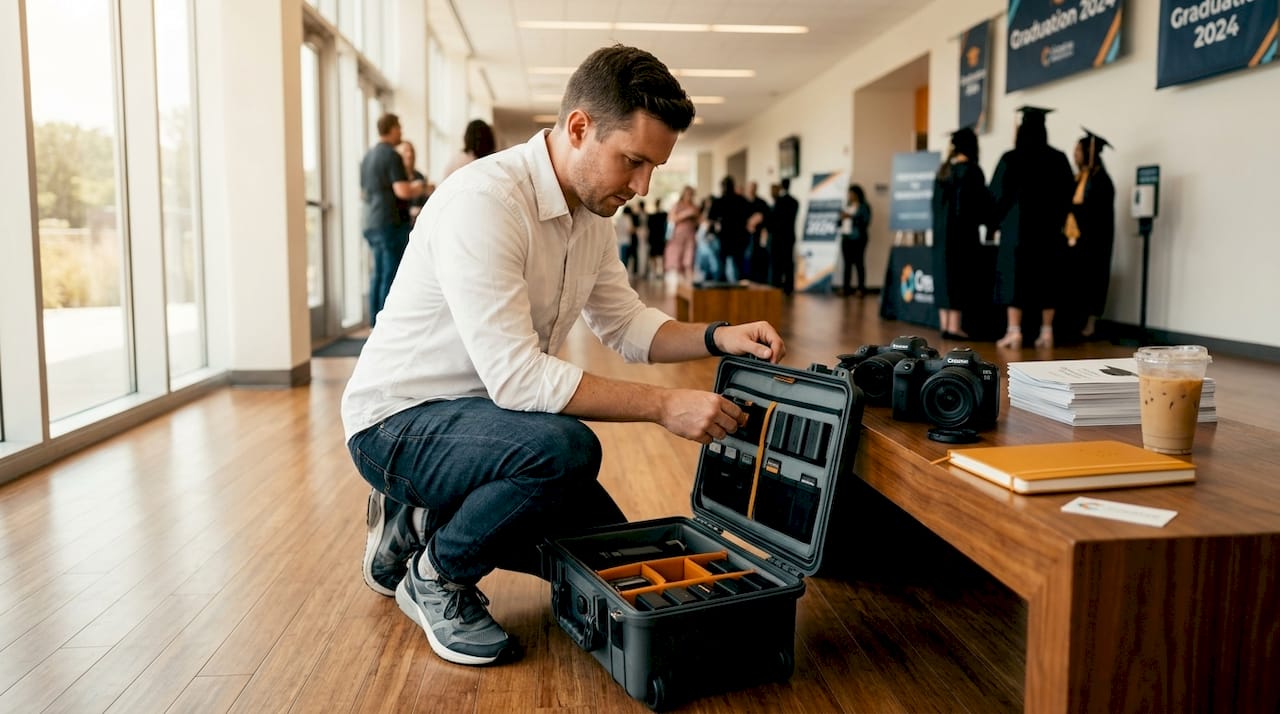
Before the ceremony, the photographer functions almost like a project manager. Equipment is checked and double-checked. Batteries are fully charged, memory cards are formatted, and backup gear is packed. The venue has been scouted. A shot list has been built in collaboration with the family, covering must-have moments and any special requests, like a three-generation family portrait or a specific group photo with a beloved teacher.
| Stage | Key responsibilities | Common challenges |
|---|---|---|
| Pre-ceremony | Scouting, equipment prep, shot list | Venue access, lighting unknowns |
| Ceremony | Processional, diploma moment, reactions | Crowds, poor positioning, speed |
| Post-ceremony | Group photos, candid celebrations | Chaos, scattered families, fading light |
During the ceremony, the photographer works almost invisibly. The goal is to document without disrupting. This means anticipating moments before they happen, like watching a parent’s face carefully during the graduate’s name announcement rather than focusing solely on the stage. Multiple vantage points and pre-arrival scouting give the photographer the flexibility to cover the processional from one position and the diploma handshake from another without missing either.
After the ceremony is where post-ceremony chaos becomes the central challenge. Families scatter, graduates cluster in groups, and the lighting rapidly changes if the event runs late. A skilled photographer manages this by having a pre-planned sequence for group shots, moving efficiently from the nuclear family portrait to the extended family gathering to friend group photos, before the moment slips away.
Key post-ceremony priorities include:
- Immediate family portrait before guests disperse
- Graduate with each parent individually
- Sibling and extended family groupings
- Friend group shots and candid celebration moments
- Detail shots: lei, diploma, cap and gown, campus landmarks
Using a smart event shot lists approach and experience with senior portraits on Oahu both contribute to capturing a complete visual story, not just a handful of lucky shots.
Professional vs. amateur graduation photography: Why skill matters
The difference between professional graduation photography and a well-meaning family member with a nice camera is not about equipment alone. It is about judgment, preparation, and consistency under pressure.
| Factor | Professional photographer | Casual photographer |
|---|---|---|
| Lighting management | White balance presets, scouting, shade techniques | Auto mode, available light only |
| Positioning | Secured early, multiple angles planned | First available spot, fixed position |
| Shot list | Pre-built, discussed with family | Improvised on the day |
| Post-processing | Color correction, culling, professional editing | Basic filters or unedited |
| Handling chaos | Systematic post-ceremony sequence | Follows the crowd |
| Emotional awareness | Anticipates reactions, captures context | Reacts to obvious moments |
| Delivery | Organized gallery, consistent quality | Mixed results, high volume of unusable shots |
The storytelling ability of an experienced photographer is the most undervalued difference on that list. A professional does not just document what happened. They create a visual narrative that shows how it felt. The nervous smile during the processional. The shaking hands receiving the diploma. The tearful laugh shared between a graduate and their grandmother immediately afterward.
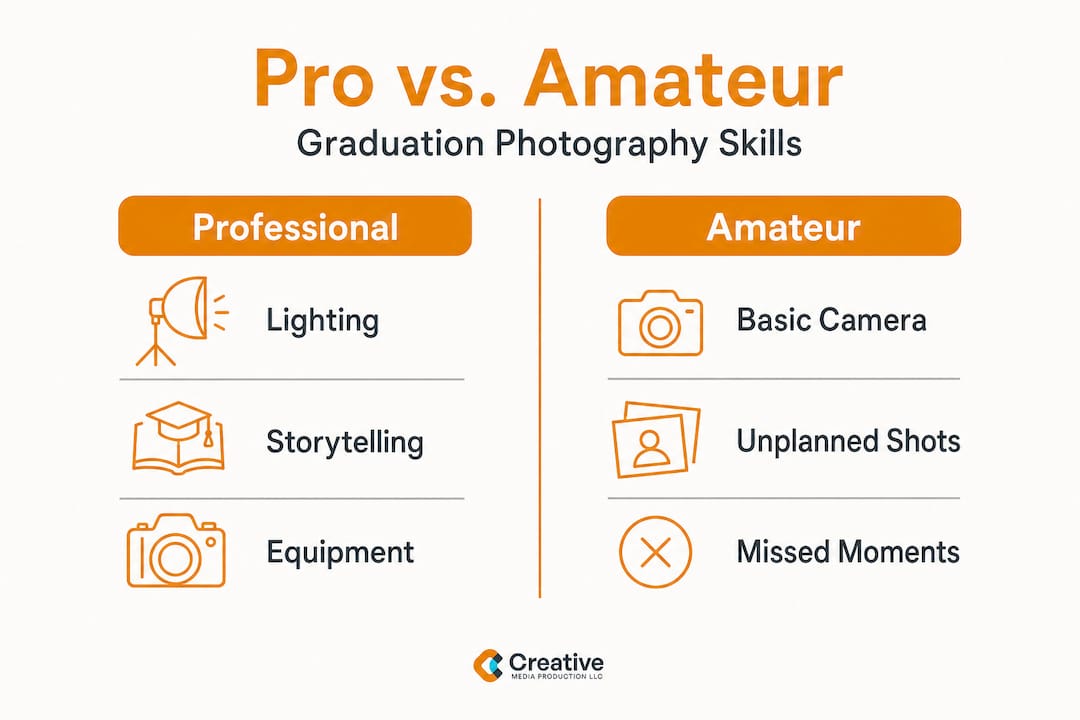
Challenging lighting, crowds, and post-ceremony chaos are consistent features of graduation events that professionals train to handle and casual photographers discover too late they cannot manage.
Pro Tip: When reviewing a photographer’s portfolio, look specifically for images from ceremony venues similar to yours. If their portfolio shows beautiful outdoor beach portraits but nothing from an indoor auditorium or crowded ceremony stage, ask pointed questions about their experience in those specific conditions.
Professional equipment also plays a meaningful role. Long telephoto lenses allow photographers to capture intimate stage moments from the family seating section without disrupting the ceremony. Fast lenses with wide apertures perform significantly better in dim indoor venues. These are tools a casual photographer simply does not carry, and their absence shows in the final images.
When evaluating graduation photo quality for your specific needs, reviewing sample galleries from similar events is the single most reliable way to assess whether a photographer can deliver what you are hoping for.
The real value: Why graduation photographers in Oahu make memories last
Here is something most articles about graduation photography will not tell you directly: the photographs matter more to the family than they do to the graduate, at least at first.
The graduate is living the experience in real time. But the parents, grandparents, and siblings are watching it happen from a distance, and photographs become the way they hold onto it. We have seen this pattern consistently across hundreds of events over more than 15 years of working with Oahu families. The graduate looks back fondly at the images years later. The parents treasure them immediately and deeply.
This is why the emotional awareness of a photographer is not a soft skill. It is the core competency. Technical excellence handles the light and the focus. Emotional awareness decides where to point the camera at the precise second that matters.
Oahu’s culture adds another layer that outsiders often miss. Lei presentations are a beloved local tradition, and the moment when a graduate is adorned by family members carries tremendous cultural weight. The specific gesture of a grandparent placing a ti leaf lei over a graduate’s head deserves the same careful framing as the diploma handshake. A photographer with genuine local experience understands this instinctively. One who is unfamiliar with local traditions may miss it entirely.
An event photographer expertise shaped by years of working specifically in Hawaii recognizes these moments and prioritizes them. Local graduation photographers who are embedded in the community bring cultural fluency that no amount of technical skill can fully substitute.
The uncomfortable truth about graduation photography is that most families do not realize what they missed until they see someone else’s gallery from the same event. By then, the moment is gone. That realization is what drives so many families to prioritize professional photography the second time around, for a sibling’s graduation or the next milestone event.
Connect with expert graduation photographers in Oahu
Your graduate worked years for this moment, and your family deserves photographs that genuinely capture what that achievement means.

At Creative Media Productions, we bring over 15 years of local Oahu experience to every graduation we cover. We know the venues, we understand the traditions, and we build detailed shot lists around what matters most to your family. Explore our types of event photography to see the full range of what we offer, connect with our Oahu event photographer team to discuss your specific ceremony, or browse our dedicated graduation photography services page to view sample galleries and package options. We would love to help your family hold onto this moment the right way.
Frequently asked questions
What should I look for when hiring a graduation photographer in Oahu?
Choose a photographer with local venue experience, a portfolio that shows work from similar ceremonies, and proven strategies for challenging lighting, crowds, and chaos. Ask about their scouting process and how they handle post-ceremony group photos.
How do photographers handle difficult lighting at graduation venues?
Professionals use white balance presets calibrated to the venue’s specific lighting conditions, and they scout locations in advance to identify the best positions using golden hour light or open shade for outdoor portraits.
Can a photographer capture both posed and candid graduation moments?
Yes. Skilled photographers build a structured shot list for posed portraits while staying alert to post-ceremony spontaneous moments, ensuring both planned and unscripted images are part of the final gallery.
How early should a photographer arrive at a graduation ceremony?
Arriving early for positioning is essential. Most professionals aim to arrive 60 to 90 minutes before the ceremony begins, allowing time to scout the venue, set up equipment, and claim the best vantage points before the space fills with guests.