TL;DR:
- Proper lighting is essential for high-quality wedding and event videos, as it shapes mood, flatters subjects, and adds depth. Careful pre-planning and adaptive techniques, like three-point lighting and bounce setup, help overcome challenging conditions and preserve venue ambiance, ensuring cinematic results. Experienced videographers on Oahu tailor lighting plans to each venue, balancing natural and supplemental light for truly memorable footage.
Lighting is the invisible hand shaping every frame of your wedding or event video. Most couples and event planners focus on venues, florals, and timelines, then assume the videographer will figure out the rest on arrival. But here is the truth: even the most skilled videographer cannot fully compensate for bad lighting after the fact. The right lighting decisions, made before and during your event, determine whether your video looks like a cinematic memory worth watching forever or a muddy, shadowed recording you rarely revisit.
Table of Contents
- Why lighting matters in wedding and event videography
- Core lighting techniques: Three-point setup explained
- Practical lighting strategies for weddings and celebrations
- Expert tips: Make lighting flatter subjects and enhance ambience
- Natural vs supplemental lighting: Finding your style
- Local wisdom: What years of Oahu event videography taught us
- Enhance your event videography with expert Oahu lighting solutions
- Frequently asked questions
Key Takeaways
| Point | Details |
|---|---|
| Lighting shapes emotion | Thoughtful lighting sets the mood and atmosphere for event videos. |
| Three-point setup basics | Using key, fill, and backlight ensures depth and flattering coverage. |
| Practical wedding techniques | Bounce, layering, and color management prevent harsh shadows and color clashes. |
| Expert advice matters | Portable LEDs and diffusion panels enable flattering results in unpredictable venues. |
| Choose your lighting style | Documentary and cinematic approaches offer distinct benefits, but balance is key. |
Why lighting matters in wedding and event videography
Ask anyone who has watched a professionally lit wedding video versus one shot under basic venue lighting, and they will immediately notice the difference, even if they cannot name it. Lighting shapes the emotional tone of every scene. A warm, softly lit ceremony feels intimate and romantic. A harshly lit reception looks flat and unflattering. These are not subtle differences. They hit viewers at an emotional level before a single word is spoken.
Beyond mood, lighting directly affects how people look on camera. Unflattering overhead lights cast shadows under the eyes and chin, making even the most radiant couple look tired. Well-placed light sources lift faces, even out skin tones, and bring a natural glow that makes everyone look their best. Depth and separation from backgrounds also improve dramatically with proper lighting, giving your video a layered, professional look rather than a flat snapshot feel.
As lighting techniques for wedding receptions confirm, lighting is essential in videography for setting mood, flattering subjects, adding depth, and adapting to challenging conditions in weddings and events. This is not just theory. It is a practical reality that every experienced videographer navigates at every event.
Lighting challenges that couples and planners should know about include:
- Uneven venue lighting with bright spots and dark corners
- Mixed color temperatures from candles, string lights, and LED fixtures
- Low ambient light during evening receptions
- Outdoor events with rapidly shifting sun angles and cloud cover
- High-contrast situations like candlelit ceremonies next to bright windows
Understanding these challenges up front helps you have smarter conversations with your videographer. And for anyone wanting to dig deeper into shooting in difficult conditions, low light event photography tips offer a strong starting point.
“Good lighting is not about having the most gear. It is about understanding how light behaves in each specific space and using that knowledge to guide your setup.”
Core lighting techniques: Three-point setup explained
The foundation of professional video lighting is called three-point lighting. This setup uses three distinct light sources placed strategically around the subject to control shadows, depth, and dimension. It sounds technical, but once you understand what each light does, you will see why it works so well for weddings and celebrations.
Here is how the three-point setup breaks down:
- Key light: The primary and strongest light source, placed at roughly a 45-degree angle to the subject. It illuminates the main features of the subject’s face and body. A common starting ratio is 2:1 between key and fill light, meaning the key light is twice as bright.
- Fill light: Placed on the opposite side from the key light, the fill light is softer and dimmer. Its job is to reduce the harsh shadows created by the key light without eliminating all shadow entirely, which would look flat and unnatural.
- Backlight (also called rim light): Positioned behind and above the subject, the backlight separates the subject from the background. It creates a subtle glow or halo effect that adds visual depth and prevents the subject from blending into the background.
This three-point lighting setup is the standard method used across professional film, television, and event videography. It works because it mimics how natural directional light behaves while giving you full control over the result.
| Light type | Position | Brightness | Purpose |
|---|---|---|---|
| Key light | 45 degrees to subject | Brightest (2:1 ratio) | Primary illumination |
| Fill light | Opposite key | Softer, dimmer | Reduce harsh shadows |
| Backlight | Behind, above | Subtle | Separation and depth |
Pro Tip: At events where subjects are constantly moving, like during a first dance or reception mingling, anchor your key light at a wider angle and raise it slightly. This wider spread reduces the chance of a subject moving out of the light zone and into sudden shadow.
For events on Oahu, where venues range from open-air beachside settings to intimate ballrooms, this setup must be adapted to the space. Our team at event videography services builds custom lighting plans for each venue before the event day begins.
Practical lighting strategies for weddings and celebrations
Knowing the theory is one thing. Applying it on an actual wedding day, with a timeline, moving guests, and varying conditions, is where the real skill shows. Several practical techniques consistently produce beautiful results.
Bounce lighting is one of the most effective and least invasive methods. Instead of pointing a light directly at a subject, you aim it at a nearby white wall or ceiling, and the light bounces back as soft, diffuse illumination. This technique works especially well in smaller reception venues and banquet halls where walls and ceilings are close enough to reflect light back effectively.
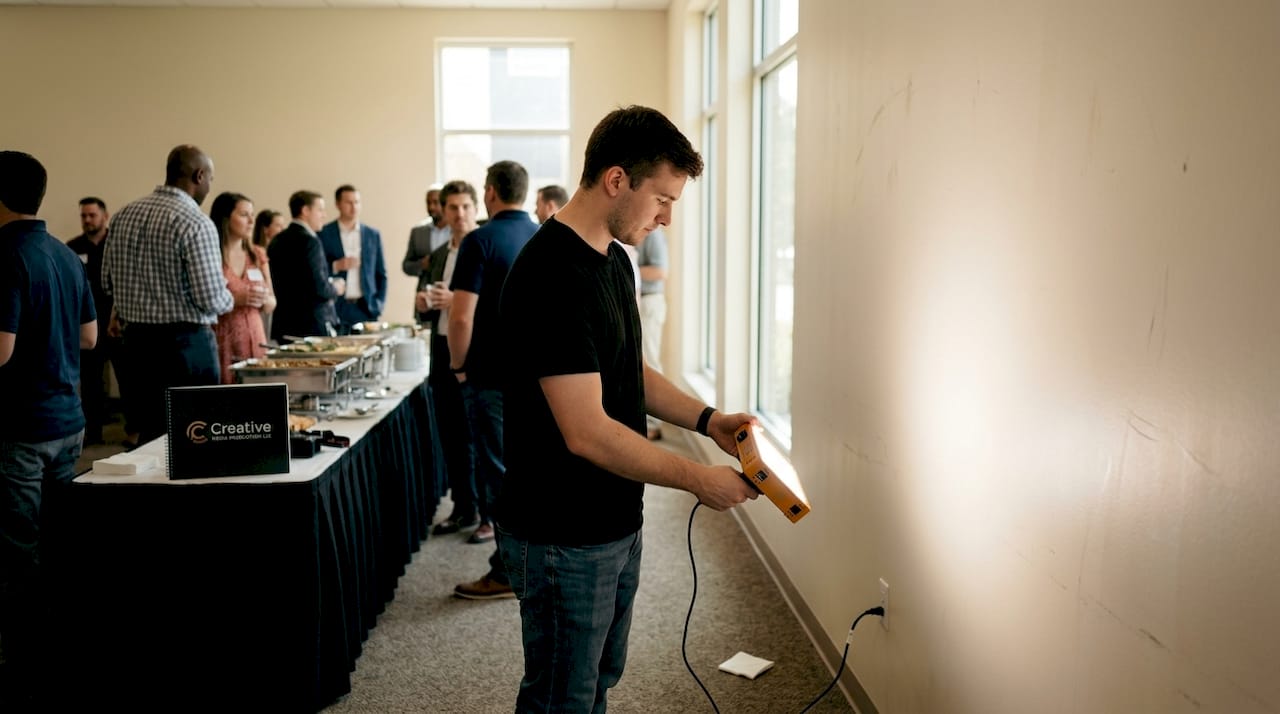
LED panels have become the go-to tool for reception coverage. They are lightweight, dimmable, and produce consistent fill light without the heat or power demands of older tungsten setups. You can master wedding videography lighting by combining LED panels as fill lights with the venue’s existing ambient light as a creative base.
Avoiding direct flash is critical. Direct flash creates flat, washed-out images with harsh shadows behind the subject. It also disrupts guests and can ruin the romantic atmosphere a couple worked hard to create. Soft, indirect, and layered light sources are always preferable.
| Strategy | Best use case | Pros | Cons |
|---|---|---|---|
| Bounce lighting | Indoor venues with light walls | Natural, soft, unobtrusive | Limited range, surface dependent |
| Direct LED panel | Low-light receptions | Consistent, portable | Can look harsh without diffusion |
| Diffused LED with softbox | Portraits and close ceremonies | Extremely flattering | Requires setup time |
| Ambient layering | Documentary-style events | Authentic feel | Less control over exposure |
Pro Tip: Before your event day, ask your venue what color temperature their lighting runs at. Most venues use warm tungsten-style bulbs around 2700K to 3200K. If your videographer brings LED gear calibrated to daylight at 5600K, colors will clash badly in the footage. Match your gear to the venue’s baseline color temperature to keep skin tones accurate and consistent.
Spotlighting key areas like the dance floor, cake table, and ceremony arch is also worth discussing in advance. These are moments that need visual weight in your video. If they are buried in shadows, even great editing cannot fully rescue the footage. Couples should ask the venue coordinator and their videographer about planned light positioning for these specific moments. More helpful guidance is available in our step by step event videography resource, and if you are still weighing your options, reviewing wedding videographer questions before your consultation can help.
Expert tips: Make lighting flatter subjects and enhance ambience
The difference between lighting that looks “fine” and lighting that genuinely flatters every person in the room comes down to quality of light, specifically, whether it is soft or hard.
Soft light wraps around faces gently, minimizing pores, smoothing skin texture, and creating gradual shadow transitions. It is the most universally flattering type of light for weddings and celebrations. Soft light typically comes from large, diffused sources like softboxes, bounce panels, or open shade outdoors.
Hard light is the opposite. It comes from small, undiffused sources and creates sharp, defined shadows. While hard light can be used deliberately for dramatic or editorial effects, it is rarely flattering for candid celebration coverage. It tends to exaggerate texture and emphasize anything the subject might prefer to hide.
As wedding videography fundamentals confirm, soft lighting flatters skin, hard light suits dramatic looks, and portable battery-powered LEDs with diffusion panels or softboxes are the preferred tools for events.
Key expert techniques to know:
- Use diffusion panels (thin white fabric in front of LED lights) to immediately convert hard light to soft light without replacing any gear
- Battery-powered portable LEDs allow videographers to move freely through a reception without hunting for power outlets
- Position lights slightly above eye level and angled downward to mimic natural window light, which is the most flattering angle for faces
- Avoid placing lights directly to the side at the same level as the subject, which creates a split-lighting effect that is dramatic but rarely appropriate for celebrations
“The goal at any event is to illuminate the story, not the gear. The best lighting setup is the one guests never notice but everyone admires when they watch the video back.”
Subjects who feel confident on camera also tend to look better on camera. Understanding poses that flatter every body type is a related principle, and the same philosophy applies to how lighting supports natural movement and expression. When you are wondering whether video or photos take priority for your wedding, the resource on photography or video for weddings breaks it down in practical terms.
Natural vs supplemental lighting: Finding your style
Not every couple wants the same look. Some dream of a raw, documentary-style video that captures the authentic atmosphere of their venue. Others want a polished, cinematic production with deliberate layering and visual drama. Understanding the difference helps you communicate clearly with your videographer before the event.
Documentary style leans heavily on available venue lighting. The videographer works with what is there, using fast lenses and high-sensitivity camera settings to expose properly in low light. The result feels immersive and real. You see the candles flickering. You feel the warmth of the string lights. This approach is less intrusive but also less controllable.
Cinematic style uses designed and layered supplemental lighting. The videographer introduces key lights, fill lights, and backlights to shape every scene. The result looks rich and intentional, with beautiful skin tones and depth that venue lighting alone cannot provide.
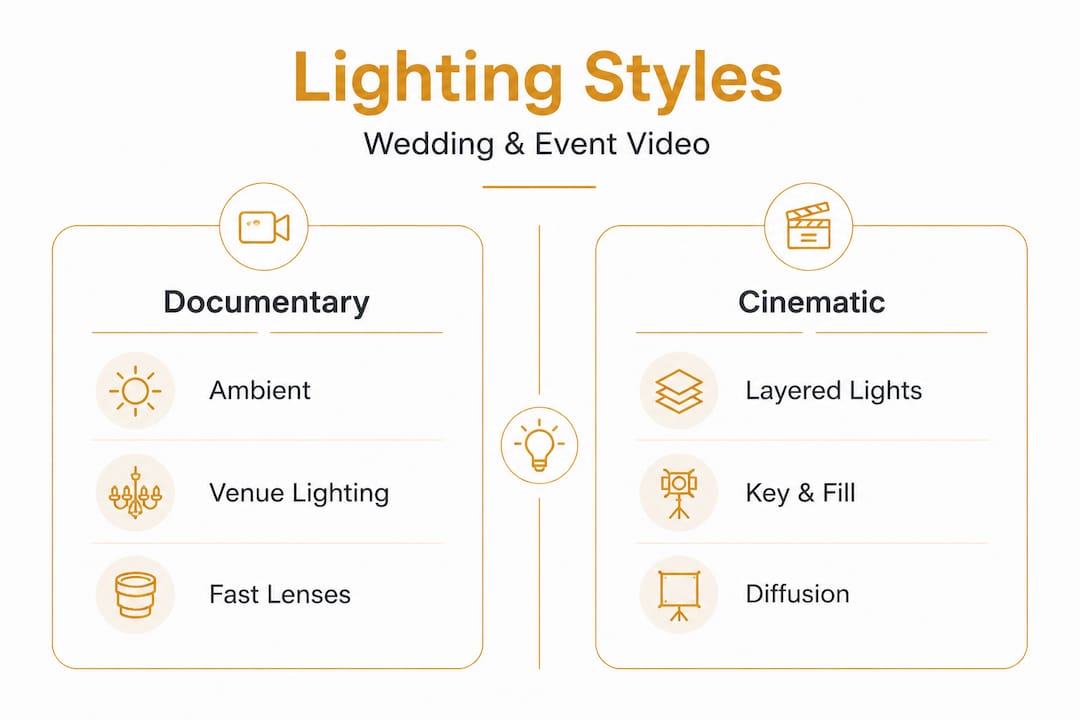
| Style | Lighting approach | Best for | Trade-off |
|---|---|---|---|
| Documentary | Primarily ambient and venue | Intimate, low-key events | Less control, potential grain |
| Cinematic | Layered supplemental setup | Statement weddings, formal events | More gear, setup time needed |
| Hybrid | Ambient base with minimal supplement | Most events and venues | Requires experienced judgment |
As contrasting lighting approaches show, the real key is balance. Overpowering a venue’s natural ambiance with aggressive supplemental lighting destroys the atmosphere a couple carefully designed. The best videographers blend both approaches to preserve mood while ensuring technical quality.
For couples planning events across Oahu’s diverse venue landscape, from beachfront settings in Kailua to ballrooms in Waikiki, the hybrid approach often delivers the most consistent results. Exploring creative event photography ideas offers additional inspiration for how lighting and creativity work together at real Oahu events.
Local wisdom: What years of Oahu event videography taught us
Here is the part that most lighting guides skip entirely: perfect lighting on paper often meets reality the hard way at an actual event. After years of shooting weddings and celebrations across Oahu, from sunset beach ceremonies to evening receptions in downtown Honolulu, a few hard-won lessons stand above everything else.
First, flexibility is not optional. Hawaii’s weather is famously unpredictable. A ceremony planned in soft golden hour light can shift to overcast conditions within minutes. Outdoor receptions that look beautifully lit during the planning walkthrough feel completely different once 150 guests fill the space and block ambient light paths. Experienced videographers build contingency plans for every lighting scenario, not just the ideal one.
Second, anticipating movement matters far more than achieving a “perfect” static light setup. Most lighting guides show diagrams with a subject standing perfectly still in a studio. Weddings do not work that way. Subjects move, dance, hug, and cry in unexpected directions. As reception videography guidance reinforces, angling lights broader to reduce shadows during movement, using gels to match venue color temperature, and relying on portable gear like LEDs and monopods is the practical standard for events. Post-production can help but controlling light on set minimizes the fixes you will need later.
Third, and this is the lesson most couples never hear until it is too late: preserving the venue’s ambient look is just as important as exposure. We have seen videographers overlight receptions to the point where the romantic candlelit atmosphere the couple paid for completely disappears from the video. Bright, technically correct footage that looks nothing like the actual room is a failure, not a success. The best videographers treat the venue’s existing light as a collaborator, not an obstacle, and bring in supplemental gear only to fill gaps.
Quick practical fix we use regularly: color correction gels placed over portable LEDs to match the amber warmth of indoor reception lighting. This allows us to add controlled fill light without introducing a jarring cold tone that screams “camera crew.”
For anyone planning their videography timeline and vendor selection, booking event videography covers the most important steps in the process.
Enhance your event videography with expert Oahu lighting solutions
Lighting transforms good footage into unforgettable visual stories, and that work starts long before your event day. If you want your wedding or celebration video to genuinely reflect the beauty, emotion, and atmosphere of your event, it takes a team with both technical skill and deep local experience.

Creative Media Productions brings over 15 years of professional experience to weddings, receptions, birthdays, and corporate events across Oahu, including Honolulu, Waikiki, Kailua, and surrounding areas. Our event videography services include personalized lighting planning tailored to your venue and vision. Whether you are looking for a trusted event photographer in Oahu or trying to decide between photo and video coverage, our team can help you make the right call. Explore your options at wedding photography or video and reach out to schedule a no-pressure consultation.
Frequently asked questions
What is the best type of lighting for outdoor wedding videography in Oahu?
Soft natural light is ideal for outdoor ceremonies, supplemented with portable LEDs and diffusion panels for balanced, flattering coverage when conditions shift.
How do you avoid harsh shadows in wedding and event videos?
Use fill light, diffusion panels, and bounce lighting techniques to soften shadows and reduce harshness on subjects throughout the event.
Is venue lighting enough for professional-looking videos?
Venue lighting alone rarely delivers flattering, cinematic results. Professional setups add depth and reduce problem shadows that venue fixtures cannot address on their own.
What is the difference between documentary and cinematic lighting styles?
Documentary style uses minimal supplemental lighting to emphasize venue ambiance, while cinematic style layers lights for drama, depth, and polished visual impact.
Should lighting be adjusted throughout the event?
Yes, as ambient conditions change from ceremony to reception and evening, professional videographers adapt lighting on the fly to maintain consistent quality throughout the entire event.
Recommended
- Event Videography Services That Deliver – Creative Media Production LLC
- Event videography step by step: capture every moment
- Oahu Wedding Videography Meets Promotional Video Production – Creative Media Production LLC
- Why use professional videography for your Oahu event
- How cinematic wedding films capture emotion and artistry