TL;DR:
- Proper coordination with your photographer prevents missed key moments at your Oahu event, ensuring lasting memories.
- Start planning three to six months in advance using shared tools like Google Drive or Trello to keep all details organized.
- Clear communication, detailed shot lists, and designated contacts are essential for smooth execution and high-quality photos.
Planning an event on Oahu is already a big undertaking, and nothing stings more than realizing your photographer missed a key moment because of a miscommunication. Maybe the family portrait was scheduled during cocktail hour, or the cake cutting happened while your photographer was still wrapping up a group shot on the other side of the venue. These gaps are more common than most hosts realize, and they are almost always preventable. This guide walks you through every stage of photographer coordination, from your very first meeting to reviewing final deliverables, so your event photos tell the story you actually lived.
Table of Contents
- Essential preparation: What you need before meeting your photographer
- Step-by-step guide: How to communicate and schedule with your photographer
- Troubleshooting and avoiding common mistakes
- Verifying expectations and ensuring successful results
- Fresh perspective: Why event hosts struggle and how Oahu can do better
- Next steps: Find your ideal Oahu event photographer
- Frequently asked questions
Key Takeaways
| Point | Details |
|---|---|
| Preparation is crucial | Gather all event details and organize them before meeting your photographer. |
| Use unified tools | Consolidated communication channels reduce confusion and speed up planning. |
| Define roles early | Assign a single point of contact to streamline conversations and avoid missed moments. |
| Verify expectations | Review the agreed timeline and shot list ahead of your event for peace of mind. |
Essential preparation: What you need before meeting your photographer
After understanding why coordination matters, preparation ensures you start the process right. Before you even book a call or send an email, you need to gather specific information that will shape every conversation you have with your photographer.
Start with the basics: your confirmed event date, start and end times, exact venue address, expected guest count, and the general style you are going for (candid storytelling, posed portraits, or a blend of both). Without these details in hand, your first meeting becomes a guessing game and wastes everyone’s time.
Critical details to gather before your first meeting:
- Event date, start time, and end time
- Venue name, full address, and any access restrictions
- Estimated guest count and VIP list (family, wedding party, executives)
- Preferred photography style with sample images
- Must-capture moments and priority subjects
- Budget range and package expectations
- Turnaround time requirements for edited photos
Once you have this information organized, choose a tool that keeps all communication in one place. Scattered emails make it incredibly easy for key details to slip through the cracks. Consolidated planning tools matter because too many emails and slow quote turnarounds create friction that directly affects photo scheduling and final results.
Communication tool comparison:
| Method | Pros | Cons |
|---|---|---|
| Email threads | Familiar, easy to start | Cluttered, easy to miss updates |
| Google Drive folder | Centralizes files and mood boards | Requires everyone to check regularly |
| Trello or Asana board | Visual timeline, task tracking | Small learning curve for new users |
| Shared Google Doc | Real-time editing, simple | Less structure for complex events |
For most Oahu events, a shared Google Drive folder with a master planning document works extremely well. It gives your photographer instant access to your mood board, floor plan, and timeline without any back-and-forth emails.
If you are planning a corporate event, reviewing a guide on corporate photography planning can give you a significant head start on what documents and details professionals expect.
Pro Tip: Build a visual mood board using Pinterest or Canva before your first meeting. Sharing it with your photographer 48 to 72 hours in advance gives them time to prepare ideas and ask targeted questions, turning your first meeting into a productive creative session instead of a general introduction.
Step-by-step guide: How to communicate and schedule with your photographer
Once you are prepared, effective communication turns your plan into reality. Following a clear sequence prevents details from falling through the cracks and keeps both parties confident heading into the event.
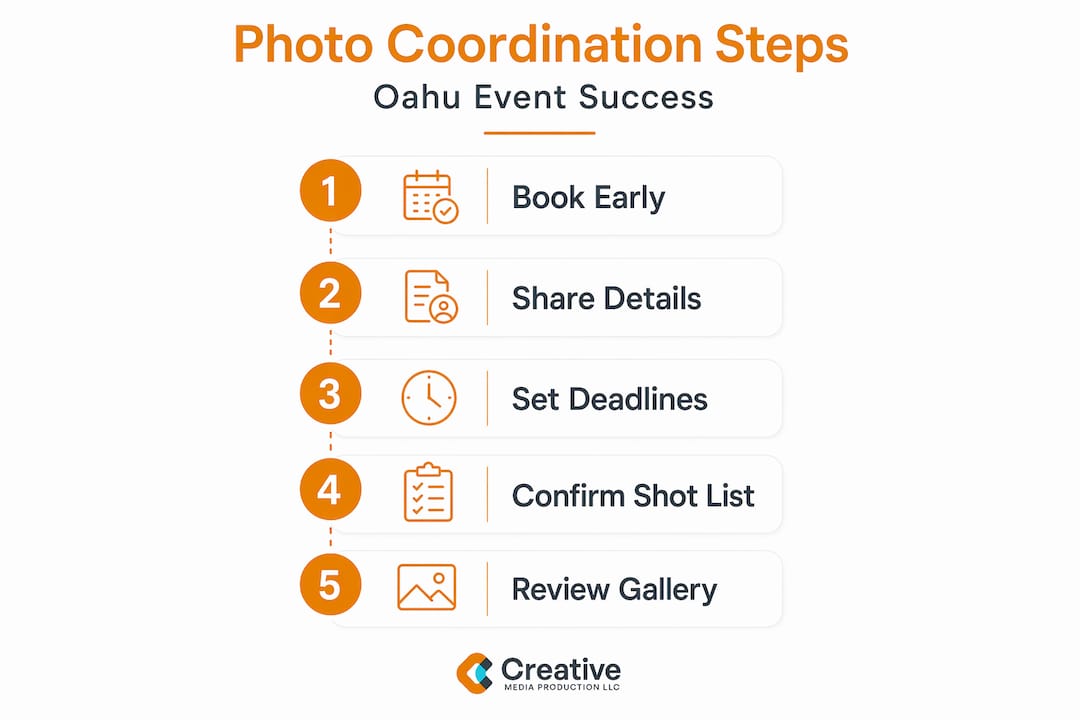
Your coordination checklist, step by step:
- Initial contact: Reach out with your event date, location, and rough timeline. Attach or link your mood board if you have one ready.
- Information exchange: Share your full event details document and ask your photographer to confirm their availability and package options in writing.
- Contract review: Read every clause carefully, especially around cancellation policies, overtime fees, and file delivery timelines. Ask questions before signing.
- Timeline building: Work together to map out a shot-by-shot schedule, including buffer time between locations or setups.
- Shot list creation: Finalize a written list of must-have photos, organized by moment or priority. A strong shot list guide helps you cover every angle without forgetting anyone important.
- Final confirmation: Send a summary email or shared document update at least one week before your event, confirming time, location, logistics, and any last changes.
- Day-of briefing: Give your photographer a five-minute walkthrough when they arrive, pointing out key spaces, VIPs, and any updates not covered in the written plan.
Using a single communication channel for schedule updates is one of the most underrated moves you can make. When your photographer, your venue coordinator, and your planner are all working from the same document, timeline conflicts surface early instead of on the day of your event.
Example timeline vs. common pitfalls:
| Coordination stage | Recommended timing | Common mistake |
|---|---|---|
| Initial booking contact | 3 to 6 months before event | Waiting until 4 to 6 weeks before |
| Contract signed | 4 to 8 weeks after booking | Leaving contract unsigned until close to event |
| Shot list submitted | 2 to 3 weeks before event | Sending it the night before |
| Final timeline review | 5 to 7 days before event | Skipping this step entirely |
| Day-of photographer briefing | On arrival at venue | Assuming photographer knows the plan |

Effective photoshoot planning shows that structured pre-event preparation directly reduces on-the-day surprises and improves overall photo quality because your photographer can focus on capturing moments rather than logistics.
Pro Tip: Set hard deadlines for every confirmation. For example, “Please confirm the final shot list by [specific date].” This simple practice prevents the last-minute scramble that causes more missed moments than almost any other single factor.
Troubleshooting and avoiding common mistakes
After setting up your coordination system, it pays to know what can still go wrong and how to prevent it before it costs you a precious memory.
The five most common coordination mistakes:
- Delayed replies: When a photographer sends questions about the timeline or venue and doesn’t get a response for several days, scheduling conflicts get locked in before you even notice them.
- Missing or unsigned contracts: A verbal agreement does not protect either party. Without a signed contract, there is no agreed standard for deliverables, timing, or dispute resolution.
- Vague shot lists: Writing “family photos” on a shot list is not enough. A vague list forces your photographer to guess, and those guesses often miss the specific combinations that matter most to you.
- Last-minute changes without notification: Switching a ceremony start time by 30 minutes can cascade into every other scheduled shot being off by an hour.
- Unclear roles on the day: When multiple people try to direct the photographer, the resulting confusion wastes shooting time and creates tension during what should be a joyful event.
Critical note: Slow communication is the hidden problem most event hosts underestimate. When responses take too long and planning tools are scattered, consolidated planning tools become not just helpful but essential. The friction from disorganized communication quietly affects photo scheduling in ways you only notice once your gallery comes back missing key shots.
Understanding photographer contract clarity before you sign anything is one of the most valuable things you can do for your peace of mind and the quality of your final photos.
Pro Tip: Designate one person as the single point of contact for all photography communication. Whether that is you, a planner, or a trusted family member, having one voice prevents conflicting instructions and keeps your photographer focused on shooting instead of fielding questions from five different people.
Verifying expectations and ensuring successful results
With troubleshooting covered, a final verification pass guarantees that what you planned is what actually happens and that you know exactly what to do if something needs correction after the event.
Your pre-event verification checklist:
- Confirm the photographer has the finalized shot list in writing
- Verify the agreed event timeline matches what is in the signed contract
- Double-check the delivery format (digital files, prints, online gallery link)
- Confirm the number of edited images included in your package
- Verify the expected turnaround time for the first gallery delivery
- Make sure the photographer has parking and venue access details
- Confirm backup equipment policy in case of technical issues
- Reconfirm your single point of contact’s phone number is current
One area where many Oahu hosts get caught off guard is post-event corrections. If your gallery arrives and something is missing or not what you expected, knowing the process in advance saves you from a frustrating back-and-forth. Always confirm whether your contract includes a round of revision requests and what the timeline for those corrections looks like before the event ever happens.
For birthday events and celebrations with multiple moving parts, a well-organized birthday event workflow can serve as a practical reference when building your own verification checklist. The principles apply across event types, from milestone birthdays to corporate anniversaries and family reunions.
When your gallery is delivered, review it against your shot list within the first 48 hours while memories are fresh. Note any specific images that seem to be missing, check the technical quality on a larger screen, and compare the delivered count against your contract. Consolidated planning tools make this review process significantly easier because your original shot list, contract terms, and timeline are all in one place, so you are comparing apples to apples instead of searching through old email threads.
Reach out to your photographer politely and specifically if anything needs to be addressed. Specific requests (“We did not receive the photo of the grandparents during the first dance”) are far more effective than vague complaints and lead to faster, more satisfying resolutions.
Fresh perspective: Why event hosts struggle and how Oahu can do better
Here is what most coordination guides miss: the biggest enemy of great event photos is not technical failure or bad lighting. It is mismatched expectations that were never surfaced before the event day.
Most coordination problems on Oahu stem from two things. First, hosts assume their photographer will naturally understand their vision without being told explicitly. Second, photographers sometimes underestimate how unfamiliar a couple or family is with the realities of event photography logistics. Both sides are operating with incomplete information, and neither realizes it until something goes wrong.
Oahu also has some genuinely unique logistical challenges. Island geography means vendor travel times are longer than people expect. Parking at many Waikiki venues is complicated. Outdoor locations like Kailua Beach Park have variable light conditions that shift fast, and some of the most beautiful ceremony sites have strict vendor access rules that need to be confirmed weeks in advance, not the day before. A photographer who does not know a site well and has not received clear location information from you is at a real disadvantage before they ever pick up a camera.
The insight most guides do not offer is this: your photographer is not just a vendor you hire to show up and click a button. They are a creative partner with a professional perspective on timing, light, and composition that you simply do not have. When you treat the relationship that way from the start, and actually ask for their input on the timeline rather than just dictating it, the results are dramatically better. We have seen this play out over more than 15 years of covering events across the island.
Choosing a photographer who aligns with your communication style is just as important as choosing one whose portfolio you love. A technically brilliant photographer who is slow to respond and vague about their process will cause more headaches than a slightly less polished shooter who communicates clearly and shows up prepared. And when you have a shared online board loaded with creative event photography ideas for your specific event, both of you walk into that event day energized and aligned rather than guessing.
Next steps: Find your ideal Oahu event photographer
You now have a clear framework for coordinating with your photographer from first contact to final gallery delivery. The next step is putting it into action with a team that already knows Oahu venues, lighting conditions, and event logistics inside and out.

Whether you are planning a wedding, a corporate function, or a milestone family celebration, Creative Media Productions has covered it all across Honolulu, Waikiki, Kailua, and beyond for over 15 years. As a trusted event photographer on Oahu, we bring both the technical expertise and the communication practices this guide describes so your event runs smoothly and your photos reflect every moment that mattered. If you are a couple, exploring our wedding photo timeline resource is a great starting point. For companies and organizations, our corporate event photographer services are designed around your unique scheduling and branding needs. Reach out to start a conversation and let us help you build a coordination plan your whole team can feel confident about.
Frequently asked questions
How early should event planners start coordinating with their photographer in Oahu?
Begin coordination three to six months before your event to secure your preferred photographer and leave enough time for thorough planning and timeline building. Popular Oahu venues book up quickly, and your photographer’s availability often mirrors that demand.
What’s the most effective tool for communication with photographers?
Consolidated planning tools like Google Drive or Trello are most effective because too many emails and slow responses create friction that affects scheduling and photo quality. A single shared document keeps everyone aligned without the clutter.
How can couples avoid confusion about the photographer’s shot list?
Request the shot list in advance and review it together before the event, making specific adjustments based on your priorities and the key people who need to be captured. Written confirmation from both sides prevents misunderstandings on the day.
What’s the best way to deal with last-minute changes?
Assign one designated point of contact and use real-time communication tools to update your photographer immediately, since even small schedule shifts can affect the entire photography timeline. The faster the update reaches your photographer, the more flexibility they have to adjust without missing critical moments.